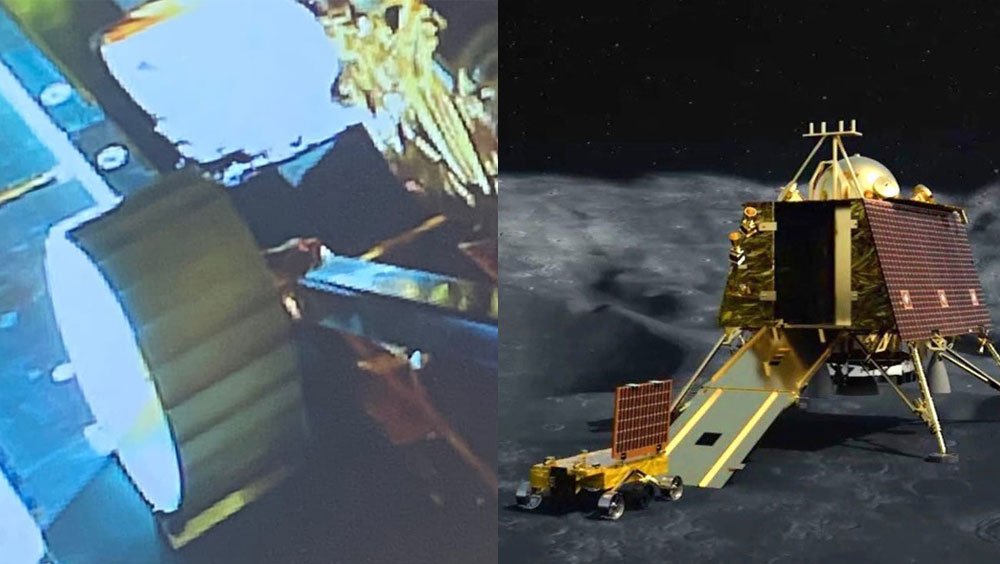
The rover deployed for Chandrayaan’s mission has successfully disembarked from the lander and begun its operations. After a smooth exit, the rover extended its ramp within the Vikram lander before making its appearance on the lunar surface. President Droupadi Murmu conveyed this significant achievement via her X (formerly Twitter) account.
I once again congratulate the ISRO team and all fellow citizens for successful deployment of Pragyan-rover from inside Vikram-lander. Its rolling out a few hours after the landing of Vikram marked the success of yet another stage of Chandrayan 3. I look forward with excitement,…
— President of India (@rashtrapatibhvn) August 24, 2023
The hindmost pair of wheels on the six-wheeled rover proudly display ISRO’s emblem, along with the Ashoka pillar featuring a lion. These symbols of India will leave their mark on the lunar terrain as the Pragyaan rover roams across its expanse. Designed to operate in the absence of life and water, these symbols will remain imprinted close to the moon’s surface.
The rover emerged several hours after the initial landing. Upon touchdown, the lunar surface kicked up a plume of dust that temporarily enveloped the lander. Only after this dust settled did the rover make its appearance. Notably, Chandrayaan-3 shared images of the landing process as well as the surface it touched down on.
Unlike their 14-day lifespan on Earth, the lander and rover are optimised for just one lunar day. During this brief window, the Chandrayaan 3 mission aims to explore a multitude of untouched elements near the South Pole of the Moon. Over the course of these fourteen days, the rover will remain operational while scientists diligently analyse the voluminous data collected by the five instruments onboard the lander and rover. The Pragyan rover will navigate the lunar environment at a leisurely pace of one centimetre per second, capturing valuable insights using its navigation cameras.
The extreme frigidity of the moon’s frozen surface accounts for the rover’s inactivity after 14 days. With temperatures plummeting to -238 degrees Celsius during the lunar night, Pragyaan enters a dormant state as it waits the next sunrise, which occurs only after the two-week lunar night. This inherent limitation highlights the rover’s lifespan, which is confined to the span of a single lunar day.